Showing posts with label Shogakko/Yochien. Show all posts

Friday, October 12, 2012

Engaging the Audience

"One, two, three, eyes on me," the teacher calls. The children, most of them anyway, respond, "One, two, eyes on you!" By the third or was it the forth time I heard this in an hour, I understood the problem.

My child has been sent away from his lessons four times, unbeknownst to me until recently. Apparently seven year old children are supposed to self report these things, not the teacher, at least until you ask, in America. Interruptions to learning are not tolerated, it is only fair to the other students. Except until it is your kid not learning, until you watch the class, until you listen to how much time is spent demanding self-control of eighteen seven year old children.

I ask to meet with the teacher. In my one on one meeting, her language is neutral and her suggestions include we reinforce listening and not interrupting behavior at home.

Earlier in the week I had gone with the class on a neighborhood excursion.

I mull over the refrain train, the children who echoed the teacher. Several children including my own were oblivious to her attention getting calls, those kids are lost in their own thoughts. Mine is busy thinking of one liners, I'm sure. We're lined up in the hallway-- need to go to the bathroom on one side, went to the bathroom on the other.

Some of us bristle at the yoke, not the work.

I bring up experiences and stories from our time in Japan to see if I can inspire reflections or new directions of thought. There are other ways of doing things, other ways of thinking. I get an eye blink and no comment, from lots of different people.

In Japan, on any outing the children are assigned a buddy, which is another classmate. They spend the outing time with their buddy. They walk in pairs. They are told where they are going, how they will get there, and they are introduced to parent volunteers. Volunteers are thanked before and after any activity.

Here, in America, my experience differs, not better, not worse, just different.

I arrive at the classroom five minutes early. There are no children present. I poke my head into the class and see the teacher alone. I ask, "Do you still need help?" She replies, "If you like." I don't know how to respond to that. I stand out in the hallway and await the class's return from I don't know where. When the children return I overhear some class discussion about the first field trip at hand, namely that it could be the last depending on their behavior, that they must find their jackets, they must walk single file, they must stay up on the curb. I am not brought into the class; I am not introduced to the class.

Twenty minutes into the "if I like" use of my time, I hear mention of the goal of our venture-- looking in our neighborhood for nature and businesses. The kiddos at the back of the line, not my own by the way, talk nonstop. The kids walk single file. Being next to them in proximity, I somehow unleash the the flow of words-- basketball, perfect leaves, Halloween, brothers, kaylees, and more. We spot a concrete mixer truck, the Red Cross building, a dead squirrel, and a few tree stumps amongst other things.

At the end of our walk the teacher congratulates the children on their safe walk and has them say, "Pat, pat, pat, yourself on the back, back, back." Most of the children knowingly reach their hands across their shoulder and pat themselves during the recitation.

You are on an airplane. The overhead monitor flips down. The cabin attendant appears in front of you with a buckle. The airline safety lecture is about to begin. You know it by heart or maybe you don't, but if done with any frequency, you begin to tune it out.

You are on a different airline. The the cabin attendant asks you to clap and stomp. He looks you in the eye. All of the cabin attendants are present, right there looking at you, engaging you. They have a clever rap you have not heard before, a new way to present the lecture. You sing, you clap, you stomp. You listen.

Sometimes inspiration from another place is helpful to get someone's attention. When you get that attention, you just might engage the whole audience.


Made you look

Tuesday, October 9, 2012

Trucking in a Science Exhibit: COSI arrives at East

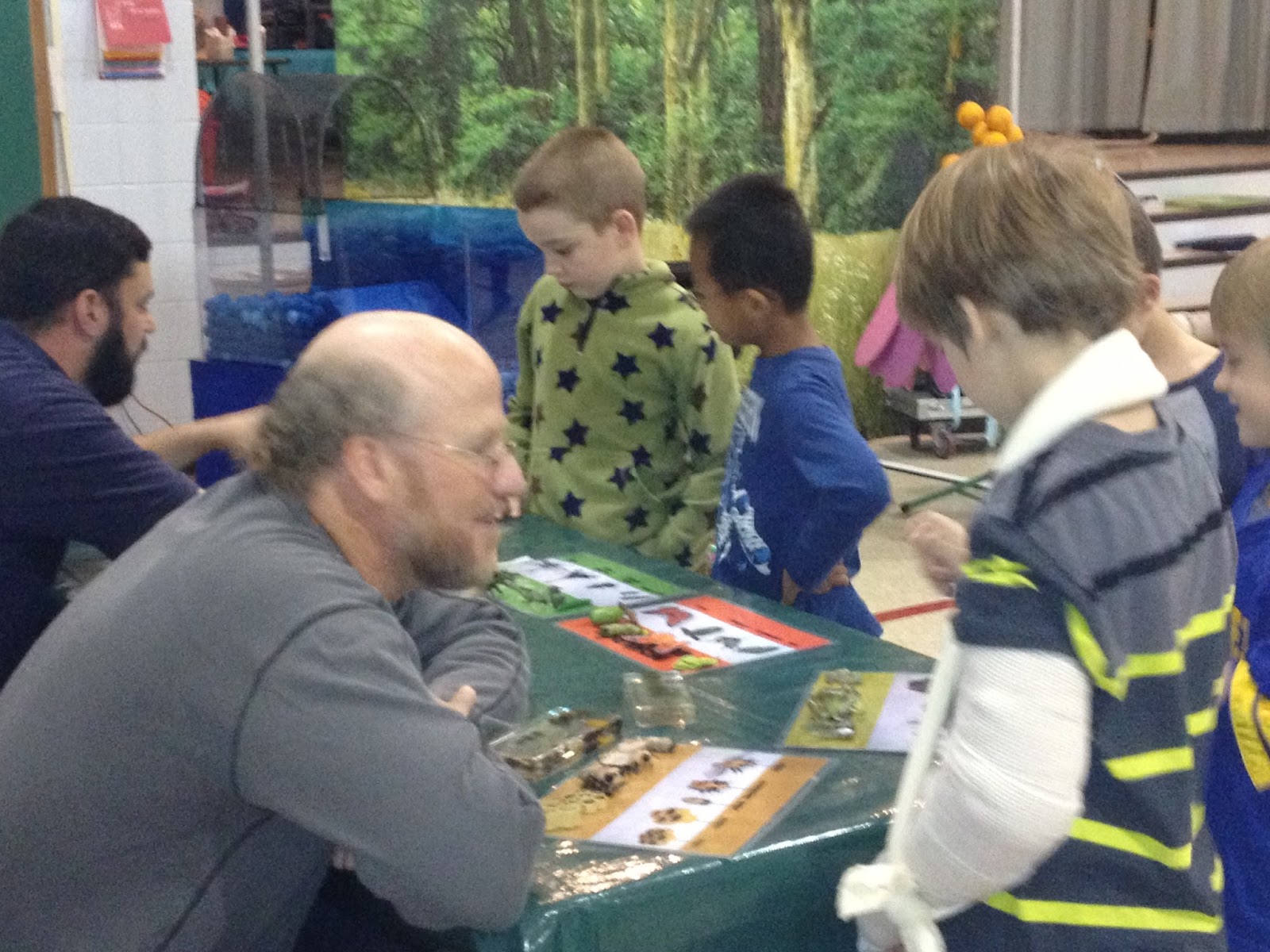
At my first PTO (parent teacher organization) meeting, I was clueless as to what COSI meant. Soon enough I gathered it was a mobile science exhibit. Today COSI came to fruition with truck contents emptied into a school gymnasium, table displays set up, parental volunteers in place, food donated for lunch, and an all student body assembly followed by time for hands on interactions between kids, science displays, and the parent volunteers who manned the stations.

Each station had a point that related to ecology and the interaction of environment and animals. There were toy bird beaks to use to get food, there were tree cookies to count the age of a tree, there were roadkill pelts to touch like the otter, there were seeds to blow into a wind sock, and models of larvae and butterflies. There were pictures of natural environments with animals hidden in the scenes. The kids could touch, feel, and try each activity. The all school assembly had children chanting, guessing, clapping, and laughing with teachers in costumes and students as volunteers.

The questions ranged from, "What is this beak best at doing?" to "Why is fur soft?" to "How does a bee tell it's friends where to find lunch?" to "Which tree is the oldest?" "Who needs camouflage more, a predator or a pray?"

I was intrigued with the outreach educator who went with activities and interactions and where the students lead with questions. It was not the usual "listen to me drone on and on" approach. When I was able to chat with her later, I asked about the program's approach to engaging the children. "When a kid says, 'Look, a bug!' You follow their lead, not because it is on your list but because it is what they are interested in. If you teach them what they're interested in is not interesting by not acknowledging it, by not seeing it, you close them down, you lose them. If you say, 'Let's all come closer and look at this bug,' you create a positive experience that shows what they are interested in, is important." She called it inquiry based learning.

I'm action oriented as are a lot of children. I became a nurse because I could do so many things like change dressings, pass medications, and assist patients in recovery after surgery. I bake because I like to stick my hands into dough. I have to sew the wrong seam, and I have to see for myself how things go together. If I can build it, make it, see it, shape it, then I can understand it, whatever the name it goes by.     Watching kids try on insect viewing glasses then owl viewing glasses and then pecking fish with a pseudo pelican beak and then making different shaped seeds disperse in different way, demonstrated to me that many others like doing, making, and interacting with the environment, whatever our age.

This event happened because a lot of people made it happen. Parents who clipped "box tops" and signed up for Kroger Community Rewards;  children who brought curiosity and papers to and from school,  volunteers who coordinated the program, ran the exhibits, and donated food, and the school and teachers that supported it being there. Engagement and interaction made it happen.

Now, what else can we do? What question did you ask yourself today?

COSI exhibit, parent volunteers, and elementary school children interacting


Saturday, July 21, 2012

Redefining Success

Fields and barns roll past my car window as I contemplate a stranger's remark and my daughter's admonishment to "never hurry, never worry" as I tend to push things along.

We are about to begin life after the Navy, but I can only conjure up the past five years with one of us working full tilt and the other juggling, home alone, like mad. It was neither satisfying nor worth replicating. My husband's long hours and assignment in a foreign country meant that my job options were few which made the decision to stay home with young children fortuitous and led to adventures far flung from the confines of the American military base that supported other families like ourselves.

We enrolled our children into a Japanese yochien preschool without bilingual support staff. I soon had my hands full taking on a new culture that came home daily with my children, new unknown expectations of mothers in Japan, and the unsung duties as keeper of the flame.

My husband's days became long and longer. Work hours consumed him. He came up for air on the weekends except when traveling, on call, or away with other assignments. He turned green around the gills, got thicker around the middle, and took a hit on his health here and there. I got angry that everything and everyone being a priority but us, his family. Something needed to give and it felt like it might be me.

He started riding his bike to work, got a tan, and improved his disposition. Realizing that I alone was responsible, I began pursuing my own happiness. Yochien mama friends guided me through the currents of Japanese culture where even an illiterate beginner can go with the flow, it's the nail that sticks up that gets hammered down in Japan.

Things changed except the reality of the ever working spouse; I could rely only on myself. All obligations and adventures were scheduled during school hours. Cultural immersion combined with illiteracy meant that I missed details, but I learned to value presence, those who showed up, and those who invited me along. My American connections meant I had access to a book group except that they met in the evenings. I threw out the idea of a daytime book group. Chirp. Chirp. The knitting regulars were hot and heavy on Thursday evenings at the on base Starbucks. Inroads to use my brain while in the trenches of motherhood were blocked. I took to reading the book group's selection each month with the hope that a random encounter would offer up a chance to talk about books.

When another Navy wife sent out an email request for places to go, things to do, I imploded. Taking on more inputs, more sights, more adventures was low on my list. I wanted to have a thought, a cohesive deep thought. She kindly responded to my request for topical discussions but then got busy and eventually moved. I craved output while the rest of the world seemed bent on inputs.

Living in a language I couldn't speak gave rise to the writer within who longed to consider thoughts relevant to the pursuit of happiness as well as to the wells of misery that sometimes trap us with trickery and falsehoods with our blind acceptance of things that may not really work despite their popularity. Being an outsider made walls of belief objects that could be dispensed with or at least moved.

Living in a foreign culture is stimulating but draining. Being the end all be all parent to my children was all consuming. Seeing my husband exhausted every weekend wasn't fulfilling either.

Weekends we road our bicycles to the beach. The sound of the waves crashing ashore, the wide expanse of sea and sand, the washed up treasures of sticks, pottery, and shells, renewed our tired spirits and offered time for play and exploration to each of us. We managed, we got through.

Diamonds form as a result of time and pressure and so we considered future options in light of present pressures. Continuing the lopsided Navy life with one of us nearly working himself to death, was dismissed. My husband, a board certified child, adolescent, and adult psychiatrist, has skills in short supply in many communities.

The options were wide open, except that we were not. Too many years away from home, like Marco Polo, meant that we wanted to go home and never leave again. His hometown, a college town without heavy industry, offered rolling hills, pockets of intellect and tolerance, a farmer's market, and opportunity, lured us.

A nursing career put on hold for five years meant that job offers were not forth coming for me. Luckily, my husband could use a good partner with a nursing and business background with skills for which I'm uniquely qualified.

In Japan we learned to appreciate the health benefits of life within walking distance of people and businesses. We found a house within walking distance of downtown in his hometown. The problem with buying a house is that there are always things to repair, remodel. Having waited twenty years to claim a house as our final resting place meant that we weren't interested in delayed gratification. The internet, long phone chats, an excellent contractor, and a tiger mom for a mother-in-law in town, allowed us to remodel from afar. A renovated house meant it was in move in condition when we arrived and that we are committed to this place, this home.

Awaiting our belongings' arrival from Japan, we took time out for brotherly love and spent a week at a family gathering on the shores of Lake Michigan. The waves crested with fresh water, the skies blazed blue, the sun colored everyone's skin. In a toy shop while searching for materials for friendship bracelets a passerby overheard me answer the constant, "Where are you from?" This passerby knowingly exclaimed, "Southeast Ohio! It's in the middle of nowhere, farms, cows..." he trailed off. The statement hanging in the air prompted me to say, "It's quiet, and I've had enough adventure." The intrusive stranger responded, "O. U., it's a college town, nice. Quiet." He seemed to soften as he moved along leaving me with the inquisitive shopkeeper and a lingering wonder at the man's initial attitude and transition toward the hills of Ohio perhaps boring and yet rich in their own way.

Like a lot of things that are given up for defunct, like time to cook from scratch, I still hang on to the romantic notion of a hometown. Maybe its that question, "Where are you from?" Maybe it's the thought of a refuge, of belonging, when one tires of exotic locations and foreign ways.

The old chapter of longing passes the baton to the new chapter of being. I aim to observe the hometown ways of American life with the same tenacity I explored being a Yochien Mama in Kamakura, Japan. In my usual way of doing things backward, I adopted the sister-city first.

My current idea of a successful life? It doesn't include money, travel, or positions of power. It does include family dinners, time to attend family events, pursing hobbies and interest along side of work, and time to cook with real food not packages of preassembled factory components with both of us working and leading a more balanced life, together.

Control of one's time may seem like our own El Dorado, the fictional city made of gold that led to the demise of a few Spaniards, but we're going for hometown life anyway.


Adventures in Hometown Living


Saturday, June 30, 2012

Farewell Yochien Friends

The source of so much of what I learned about culture and life in Japan resulted from my children attending Kamakura Yochien preschool and kindergarten. Yochien Mamas spend a great deal of time together picking up and dropping off children, walking to and from the bus stop, attending meetings, participating in events, and organizing what is left of free time to have some fun together. What a magical time and place!

Raising children is a busy time in the life of every mother. I was privileged to learn from the Japanese mothers' approach and reflect on my own. At times, my instinct was the very opposite of theirs. They never said much about it, they seemed happy I was trying. I tried like the dickens, and often I felt like a barbarian in comparison, but it was the fun, the learning, and the acceptance that kept me going.

Nowadays I appreciate that I have time to pursue my interest in writing, photography, bookmaking, sewing, and cooking, but the connection to the other mamas at shogakko elementary school is less involved, less overlapping. The discovery of three yochien friends as classmates on the Moose's first day of shogakko elementary school meant that I had yochien mama friends there too.

The goodbyes are tumbling in as we hunker down for our final week in the neighborhood. Yesterday, we all took a bit of time in the afternoon to return to the park by the yochien for one last romp together. The teacher that taught both the Mule and the Moose came with her baby. We hadn't seen her since the Moose's graduation which was days after her baby's birth. The baby is more toddler now. I am happy to report her sensei teacher magic is still intact. All of the children were thrilled to see her and to play some games together.

A big piece of my heart went unspoken during these years because of the language barrier. Slowly though I learned to let go of the need to say as much, to let the laughs come, to bring what I could to the moment, to accept that sometimes you just have to be there, and that words are not the only way to communicate. I think these things simmered in me so long that it pushed me to finally begin what has become a passion for me, writing.  As I share the stories of daily life worthy, I hope, of further reflection, I realize that I am all the better for the journey we took together, words or no words.

Mate ne yochien friends!
Our farewell tunnel!
Yochien friends at the park
The Mule chasing her old Sensei with her little guy

Friday, June 29, 2012

Mata Ne またね Party

Kendo Mama told me that though "sayonara tomodachi" is the right translation, it sounds like an eternal farewell or a break up with a lover.  I went with the casual yet childlike phrase "mata ne" (again, okay?). I'm not ready to give up my friends here just yet so this seemed to fit the bill.

My fear about this adventure was in a culture known for a dislike of foreigners, would I be included. I was embraced by the Japanese Mamas like no other place. The hardest thing to say at my mata ne goodbye party was, "Thank you for every hello. Thank you for playing with me. Thank you for your willingness to simply be present with me when we couldn't find the words in the other's language." You feel in your heart what someone means when they are with you, words or no words.

We shared a significant time in our lives of raising our children in Japan. Despite cultural differences and language barriers, in five years, we laughed, we hiked, we ate, we sang, we danced, we shared, we cried, we had fun, and we made deep and lasting friendships.

How we interact will change. It will be photos posted on Facebook, quick notes via email, Skyping over the internet, and someday perhaps a long flight on a plane, but it will continue. Besides, they have a vested interest in seeing how a couple of blonde nihonjins keep up their Japanese. I look forward to the day when I can shepherd some of them or their children through my culture. The group cohesiveness makes this place hard to replicate. Most who have experienced this belonging can vouch that it is one of the best parts of the cultural exchange. I had worried for not all those years ago.

It was thanks to my first Japanese friend that I threw myself into this whole adventure in the first place. She had told me, "If anyone can do it Kim, you can." With that vote of confidence, those were my starting words. Thank you Kimiko for giving me the courage to try.

Juliet said it best, "Parting is such sweet sorrow...." However, a party is the way to go. We shared how we had connected and some of our favorite memories. We ate wonderful food. We had a quiz show, and I handed out American products for prizes like Jalapeño Cheetos, a roll of paper towels, and a bottle of Heinz ketchup while wearing a yukata they dressed me in. I was not sure anyone would guess the answers to some of the quiz questions, but they got them all eventually! It was funny to hear their responses too.

"Favorite Japanese movie?"
"Your idea of a handsome Japanese man?"
"What Japanese food will you eat when you return?"

It was meaningful, it was fun, and  I'll part with mata ne.


Mata Ne Goodbye Party!
Japanese finger foods


My favorite picture- them reading my parting gift!
This book was inspired by them and our time here


Monday, June 18, 2012

Gaijin Tips for Living in Japan

Reflecting on what advice I would give to newcomers to Japan, after five years of living here myself, I have a few thoughts. I won't get to them all in one sitting, but here's a start on tips and advice to consider when moving to Japan from one gaijin to another.

Do One Thing

Do one Japanese connected thing while you're here, such as archery, cooking class, ikebana, kendo, teaching English, etc. Explore other venues that interest you, but stick to that one thing. The longer you stay with it, the deeper you will go. It will impact how and what you learn and the relationships you form. As I thought about the value of the sticking with one thing, Zen and the Art of Archery which reflects on cultural lessons learned through the practice of archery in Japan came to mind. I can't say I planned my own experience this way, but it is what happened with me and my Japanese Cooking Class. I wanted to take cooking lessons to learn about Japanese food. Within two months of moving to Kamakura, I found Nansai Sensei's monthly cooking class. My comprehension of what I was doing and what was being said improved because of both repetition and to some degree the limited subject matter, primarily words about food and technique, but my relationships also deepened and became  more valuable than the cooking lessons themselves.

If you have a hobby or interest, it may well be enjoyed here, perhaps on a grand scale or with a twist. Look for trade shows and opportunities to see how they do it. I'm always amazed at the depth of knowledge and the level of interest in crafting, food, music, etc. Seek out the Japanese ways. They are known for perfecting what others invent. There is some truth to that stereotype.

Get a Black Suit

You need a black suit and a string of pearls (women). You can attend a wedding, a funeral, a party, a business meeting, in a black suit in Japan. It is versatile and will help you to blend in. Wearing peacock colors in a roomful of black and white at a cocktail party might be fine, but if you have a meeting, you want people looking at your face not your clothes. Same goes with the wedding, you don't really want to stand out as a guest, that's the bride's job. I'm not immune to fashion, but what I'm trying to get at is, at certain times your role is not to stand out. You are there to attend a wedding, make things happen in a meeting, or pass along your condolences; it is not a fashion statement opportunity. There are plenty of those events in life assuming you seek them out. As a gaijin, you by the way, are hard not to notice.

Wait in line & Zip it

Wait in line. Everyone waits in line, just get in line and be quiet. The Japanese are generally quieter than any other culture I have been around. My neighborhood is more densely packed than any I have lived in before and still it is quieter. Trains? Quiet. Line up and shut up seems to be the easy thing to do. You can of course text and walk or bike and text. My fellow Americans, we tend to talk too much, try to observe the natives for tips and zip it.

Quick Dry Fabrics

On a practical front for those who will live in Japan, at least the parts around Kamakura, it is green, very green in summer because there is a lot of rain. This means that it is humid. It may not surprise the rest of the world, but Americans will not find clothes driers in regular use here. I replaced my husband's heavy cotton t-shirts with quick dry ones. Sheets can take days to dry and towels too. I converted over to microfiber waffle weave bath towels. Hanging your bedsheets outside to dry means that you need to consider your wash load, hanging space, priorities, and the weather. Flannel and cotton can take a surprisingly long time to dry if it's cold or wet outside; it feels like this most of the year. Consider fabrics such as fleece, microfibers, blends of poly-cotton, or even Uniqlo's heattech selections.

Necessary Accessories

Wear rain gear. Maybe it's because the Japanese walk to and from the train stations for work or for shopping, but rain gear generally includes a coat, boots, and an umbrella. The rain can be heavy and continuous, be prepared. You will find plastic sleeves to contain your umbrella drippings at entrances to shops; use them. Consider having an umbrella of the more normal size for Japan, large golf umbrellas do not tuck so neatly into umbrella sleeves or allow you to politely pass others in narrow confines which are numerous in Japan where you will share the sidewalk, if there is one, with bicycles and people.

You need a hand towel. I'm terrible at this, but a hand towel should be in your purse, back pack, or bag at all times. Public restrooms in Japan generally do not offer hand dryers or paper towels, eliminating messes and electric costs, but it means that you will be walking with dripping wet hands if you don't heed this custom. Men usually have a backpack, briefcase, or even a man-purse of some type. Everyone needs a hand towel. Children may use their parents' hand towel, skirt, pants, etc.

While we are on the topic of accessories, women carry a purse and a bag or at least will have a bag that can be used in their purse to carry additional items. Slippers are necessary in some situations, particularly if you will go to yochien or shogakko events. Scuffing about in the institution's slippers is never my favorite, but bare feet or even a pair of socks tend to earn a few stares. Slippers would be carried along with a bag for your shoes, in some cases, to the event. If you have an identification badge, it would be worn as well once you arrive at the event so always take it with you.


We didn't really go native


Friday, June 8, 2012

The Bridge Between Two Cultures

I've been asked, "Why did you choose to live in Kamakura?" As well as, "Why didn't you live on the base?" And recently, "If you had to do it over it again, knowing what you know, would you still do it?" I realized with this bundle of questions that I mainly saw the choices along the way as opportunity. Choosing Kamakura was an opportunity to tip destiny in the direction of learning about Japanese culture.

When we found a house to rent in Kamakura five years ago, I told the agent, "I'll take it if you can find a yochien Japanese preschool that will enroll my children." As agents go, he was motivated and called back with, "You have an interview scheduled." Having arrived in Japan from Washington, D.C., I was not surprised at needing an interview for preschool. My husband's new co-worker supplied us with a contact for a translator and so our adventure in Kamakura began. Choosing yochien was an opportunity to learn another approach to childrearing.

Our daughter took to Japan like a fish to water. It was if we had been depriving her of rice, tofu, and giant concrete slides her whole life. She had previously spent a year, at the fine age of three, attending the French Maternal Preschool in Georgetown so immersing in Japanese was hardly cause for alarm. She hadn't known any French when she started.

I was pretty clueless to the ways of yochien. Months went by before I finally asked at the bus stop one day, "Why do they keep bringing their shoes home on Fridays?" The laughter was because I was supposed to be washing them every week. Tissue and handkerchiefs were supposed to be tucked into the children's smock pockets. I meant to sew velcro buttons on the pockets to hold stuff in, but never did. No one commented on the obento lunch box meals I packed and sent off daily. Over the years as I learned more and was schooled by my ever wiser daughter, I learned that putting packages of any type into an obento was verboten. I had been putting packets of tofu into her obento for two years at that point.

After yochien graduation, we expected to enroll our daughter into the local shogakko elementary school. Being American, I thought every child in the neighborhood was entitled to a local education, but being here under the sponsorship of the U. S. Navy meant that we were supposed to attend the American elementary school at Yokosuka Naval Base, forty-five minutes away. Explaining our desire to send our blonde, blue eyed daughter to the local elementary school in the end resulted in a meeting with the Kamakura City Board of Education. Other Navy children that attended local elementary schools either had a Japanese parent or were in the school district near the base. Kamakura had never had a Navy family, without a Japanese parent, attend a local school. Choosing shogakko was an opportunity for our daughter to expand her Japanese.

The Yokosuka Navy Base, around this time, had created a job for a school liaison coordinator. She suggested that I contact the base legal office to discuss the issue with the base Japanese lawyer. He told us that the city was not obligated to educate our daughter, thanks to the S.O.F.A. (Status Of Forces Agreement for you landlubbers), but that they might consider it if we asked. We went to the school board meeting knowing we were going against the tide.

My husband and I put on our darkest suits, de rigueur in Japan for any formal event. A good friend and fellow yochien mother, who knew us and more importantly our children well, offered to translate. Another friend had insured we got the meeting scheduled in the first place. It was all about a little girl with pigtails who had earned the chance, nothing more, nothing less. I was nervous but earnest.

There were four members present for that first interview with one being a translator. I was sweating inside my suit. They asked us if there was a bus to take our daughter to the American school. "Yes," we replied. They asked us if there was a school for her to attend on the base, "Yes," we replied. They asked us a lot of stuff that had me confused because it wasn't about our daughter. Sensing that the point was being lost I spoke up and told them that we were there because our daughter deserved the chance to go to school with her friends and neighbors, that this wasn't about money or funding or transportation, but it was about a little girl who came to Japan, learned Japanese, and took to Japan like a native. One member looked up at me and said, "She is a bridge?" "Yes!" I replied, "She is a bridge, she is the link between Japan and American already and in the future." I knew then that they got it. Not long after we received the all important post card in the mail; her entrance ticket into shogakko elementary school.

That little girl, the bridge, is what has carried me across the cultural divide, the obstacles of being a gaijin in Japan. Turning back was never an option. Though I have not made a great effort to learn the Japanese language, too overwhelming, I have sought mightily to learn the ways of the culture. I will never blend in here, with my pink skin, blue eyes, and unmanageable hair. I do love the connection this bridge has made even if building it has meant that I lost touch with some of my own cultural comforts, the main one being the chance to be smarter than my children for a while, but I can't read, write, or correct their manners or homework.

I have often thought of myself as somewhat of a pioneer here in the wilds of Kamakura, which excepting the spiders, bugs, and green plant life that take over, is quite civilized. The term pioneer may not be entirely accurate as there are plenty of other gaijin about, just not mothers at school, and I never intended to blaze a trail for others to follow.

I played a small part in building a bridge, and I can't take back one iota of this experience without dismantling that and so, no, no regrets.


1st Day of Dai Ichi Shogakko for "the bridge"


Sunday, April 22, 2012

Falling Petals

Observation Day at Shogakko

Shogakko Japanese elementary school observation days fill me with appreciation and dread. I stand about listening to "wah, wah, wah...," clueless as to what is being said, the point of the exercise, and I miss all of the humor. The Mule's class is always the toughest for me. Some how my mama friends in the Moose's class manage to surround me and carry the day, I'm a member of a group there.

Here, I'm standing in the back of the third grade classroom observing a lesson with other parents but feeling very alone. An orb of anxiety grows in my gut with all that I can't comprehend. Even the Mule refuses to speak to me at school because I speak English, and she does not want anyone to see her speaking English. 

In Want of Support

Walled off, my mind spins. I become furious with my husband for not making the time to be here. I'm yet again by myself, and I'm not liking it one bit. In need of relief from my thoughts, I walk out to the hallway to distract myself. I spot drawings on the wall and recognize my daughter's name in hiragana. This is her picture.
Sakura cherry blossom petals falling
A dad wanders by and eventually begins a conversation with me with a smattering of English. I am grateful nonetheless. Dads are more likely to use English in business so I find that they will spontaneously chat with me versus the other mothers who unless they know me from before, do not speak to me. One question he does ask me is, "Where is her Papa?" Boy isn't that a novel idea. I managed to contain myself and explain that the Navy doesn't slack off much with the ships in port, not that there were a lot of other fathers there, but I would have liked the support.

Skipping Meetings

When the kids departed school, and I made up my mind to skip the parent meetings. I collected the agenda, but I skipped both the all third grade and individual class meetings. I couldn't do it. I was too close to that feeling I had two years prior when I broke down in tears when they asked me to introduce myself- it was all those papers I couldn't read and all of that Japanese I couldn't understand. Now it is mainly that I have had enough, why isn't her father helping me with this stuff, why am I still here, and how much longer do I have to be an idiot. Yep, I'm feeding that wolf again.

Later, I told the Mule I had skipped the meetings because it felt too hard to do. I didn't really have an excuse or any bits of wisdom, but I wanted to be honest, clear.

Perseverance

After pizza, we mostly make pizza on Fridays and this was a Friday, I went up to the office while she and her brother watched an episode of The Backyardigans. She came upstairs with an obento she had made for me- a peanut butter sandwich and a green salad with a bottle of dressing. She said, "Putting the dressing into the bottle was the hardest part." She had persevered; I had not.

Monday, March 19, 2012

Pizza & Bags

Friends over to Play & Eat

The half days have begun. It is the last week of Shogakko. There was no lunch today and so my children invited friends over for lunch. My approach to cooking for Japanese friends as well as children is to cook within my comfort range, not something they know better than me. I made pizza.

One youngster guest inquired in Japanese if I had made the pizza dough myself. My daughter translated back my answer of, "Yes, I did. Do you like it?" The long and the short of it was that she asked to take a pizza home to her family so they could eat it. Apparently neither her grandmother nor her mother makes pizza from scratch. I sent home four slices of pizza reluctant to send home a whole pizza when I had yet to eat my lunch--I was busy feeding the frenzied crowd.

The Japanese boys won my cooking mama heart today. They ate the pizza and ate the pizza pronouncing it oyshi while eating. Later one of the boys asked me for more pizza. I tried to explain that there was no more by pulling out my favorite phrase for the end of a book, oshimite! He understood. I had a counter offer for him and his eager response was perhaps also disbelief, "Nikuman? Nikuman?" I took that as a sign of interest and then the next thing I knew there were three boys eating last night's leftover nikuman (pork steam buns). They too were pronounced oyshi. They asked me if I made them myself. I understood the question better this time. I replied, "So, so, so."

I need to have Japanese children over more often. They make me think I am a reasonably good cook!

Meanwhile my husband was upstairs abstaining from food in preparation for a medical exam tomorrow. Later he joined us for tea and birthday wishes. Over the weekend the Moose had pointed out that though we celebrated his birthday and had cake, there were no birthday candles and thus no birthday wish. I conjured up a batch of brownies in time for his guest's mama to arrive for tea. She arrived bearing gifts as if it were the Moose's birthday in Japanese fashion. I was glad I had stopped my sewing project and made time to bake. The Mule had absconded with her friend the pizza lover but she is not one to like brownies anyway. Her friend would have liked the brownies, as they were sweet, gooey, and dense. I still don't know what the Moose wished for, as it should be I guess.

Sewing Projects

While the boys played, I sewed yet another bag I hope will be for my mother. This time I checked that the fabric print was in an appropriate direction before I cut it. However, I soon realized I had made other sorts of mistakes. I was too lazy to return to work on it after my wee ones went to bed. Well, the truth is I was distracted reading the web, Facebook, and searching online for I can't even remember in the comfort of my bed within range of the kerosene heater. Not so productive as finishing my bag but I guess I could chalk it up to searching for inspiration.

Early tomorrow I will drive my husband to the train station, feeling guilty that I am not accompanying him for his procedure. I then plan to take my children who have a Japanese holiday to my sewing circle which happens to be nearby the hospital where my husband will be so I can get a bit of the sewing wisdom to be imparted in hopes that I can work on the new project after I pick up my husband and return home.

I feel like a sewing addict already!

I have some bag photos to post as I'm sure you await with baited breath my upside down bird bag. Take a look.
My upside-down bird bag :-) 
This bag taught me the value of buying a larger piece of fabric- it was too small for the pattern
This was the leftovers from my bunny bag
How about that pizza dough recipe.

Pizza Dough

Bread flour, 3 1/4 cups or so, 1 cup at a time
Salt, 1 tsp
Yeast, 1 slight TBSP
Warm Water, 1 1/3 cups
Olive Oil, 1 TBSP

In a large bowl, whisk together 1 cup of flour, the salt, and the yeast. Add the warm water and oil. Whisk together 1-2 minutes until smooth. Then using a spatula to stir, add flour 1/2 cup at a time until the dough is not sticky which is usually about 3 1/4 cups but not always. Switch to using your hands to knead the dough about 5 minutes. Form into a smooth ball. Cover with plastic wrap and allow dough to raise until double in a warm draft free place, about 1 1/2 hours. Rub olive oil on your hands, deflate the dough, and divide into 3 balls. Cover with plastic wrap and Again allow dough to raise until double (if you have time), about 45 minutes. Heat oven to 200ºC. Oil down a pizza pan. Stretch a ball of dough out using your hands, pressing from the center outward with your thumbs, gently stretching it like they do at the pizza parlor, add toppings such as olive oil, salt, parmesan, mozzarella, salami, basil, and tomato sauce.

Bake at 425ºF (~200ºC) for 10 to 12 minutes or until golden brown. Makes 3 pizzas.

Idatakimas I humbly receive,
Kim

Friday, March 16, 2012

Bitten by the Bug

Flu Days

In Japan children don't get off from school for snow days as all of the children walk to school- there is no bus to worry about navigating snowy roads. However, they do get flu days off. When a certain threshold of children sick with the flu peaks, then the particular class is canceled. This results in part from the majority of the children not being immunized for the flu and kids being kids, they are the plague ship rats that spread the disease and take the rest of us out of commission.

The Moose's class had been canceled earlier for two days, but my children, being immunized, had managed to skate through flu season unscathed. Then I got bitten by some version of the bug. It took me down- I was falling asleep five hours before my usual bedtime. My husband arrived home several nights this week to a dinner table full of dishes and a sink full of pots while I was passed out in front of the kerosene heater, fully dressed and wearing my cooking apron. I have finally made the turn. I managed to clear the table and wash the dishes before he arrived home last night.

I didn't let a bug deter me from my sewing, however, and I did roust myself to get my now repaired camera lenses. I had to skip out on the Japanese Nail Party which I hope to go to when school resumes in the spring. I did also attend a luncheon with a guest speaker that discussed the pearl industry and how to buy pearls. Unfortunately with all of our money in our new old house it will be a few more years before I will be considering pearls. The pearls are lovely and because the Japanese control the industry, there is every kind of pearl here in Japan- the black Tahitian, the pink, the cream, the oddly shaped. I can only hope to find an excuse another time.


The End Nears

This week was the last of the full days of school. Next week there are only a few half days and then the current school years ends, only to resume at the beginning of April with everyone advanced to the next grade. I dread having the Moose start second grade as the amount of work will increase and though he has made vast strides in his Japanese, I have concerns that it will be tough, perhaps tougher on me since it bothers me more than him when he is not doing well. The Mule keeps flying through Japanese school life with ease. I swear this blonde blue eyed girl was born Japanese in another life or at least has an Asian heart, something.


A Zipper

My ever favorite bag lady taught me how to do a zipper. A zipper foot for my machine is on order from the States. When it comes, I will practice more. I learned a lot and of course made a lot of mistakes. I keep making mistakes, but it doesn't deter me. All of my fabric is from the remnant section at Swany so I do not feel any creative impediments to making things and making mistakes.

I worked very hard on a bag last night, still unfinished, only to realize I cut the patterned fabric upside down so as cute as it is, the design is upside down. The bag itself is made better than the first one I did and I managed to do it by myself. Win some, lose some. I was really making it for my mom so it will be a little longer before I can make her retirement gift. She retires at the end of the month so my time is running short.

I am loving the plastic or wax coated fabric from Swany. I made the small pouch with my first zipper with my Short Bus Sewing Circle, and then I made a small book bag on my own, no zipper of course.

Zipper bag with fabric from Swany 
Small book bag with fabric from Swany

Thursday, January 12, 2012

A Gaijin Reads a Story

JULES: Oh, it ain't quite time yet. Let's hang back.
Pulp Fiction written by Quentin Tarantino


The five first grade classrooms are on the same hallway. Each classroom has two doorways that open onto the hall. The first doorway is the back of the classroom where all of the cubbies are for the children's stuff. The second doorway is the front of the classroom where the chalkboard hangs. A few mothers, evenly distributed down the hall, stood near the back door of each classroom.

I read the scene, noting that the other mothers were hanging back, awaiting the clock to strike 8:30 a.m. My mind wandered to why the children were sitting on the floor at the back of the room, including my own son. Entering the classroom, at 8:30 a.m., I laughed aloud- the chair in which I was to sit was obscured by children jockeying for position for storytime. I was there to read, in English, to Japanese first graders for fifteen minutes.

If someone announced, "A polar bear has entered the room," this may give a sense of the rarity a gaijin's appearance has in this situation. I garner the children's awareness by exoticness. I started in with, "Ohioguzimas!" They eagerly retorted, "Ohioguzimas!" I'd hooked them. They echoed "good morning" and all sorts of things after that no problem. They counted from one to ten in English as I pointed to the rubber ducks in the storybook. Pick a random American school: how many of the first grade children could, unprompted, count to ten in Japanese? I was impressed, and I loved the smiles on their face. I called, they responded.

Later one of the office workers at the elementary school told me that the Moose, "is so happy that his mama came today." I laughed and said, "I could show up in my pajamas and he would be happy." He's a mama's boy. I'm just lucky enough to be his mama. Being a mama is about cleaning a lot of crap, but it is also an inside track to the privilege of watching a personality form. When your children are so different from each other, from you, it is easier to see where you end and they begin.

"On Children"
Your children are not your children.
They are the sons and daughters of Life's longing for itself.
They come through you but not from you,
And though they are with you yet they belong not to you.

You may give them your love but not your thoughts,
For they have their own thoughts.
You may house their bodies but not their souls,
For their souls dwell in the house of tomorrow,
which you cannot visit, not even in your dreams.
You may strive to be like them,
but seek not to make them like you.
For life goes not backward nor tarries with yesterday.

You are the bows from which your children
as living arrows are sent forth.
The archer sees the mark upon the path of the infinite,
and He bends you with His might
that His arrows may go swift and far.
Let your bending in the archer's hand be for gladness;
For even as He loves the arrow that flies,
so He loves also the bow that is stable.

Kahlil Gibran
Storytime for ichi nensei (1st graders) with Mama Gaijin

Friday, January 6, 2012

Story Reading & Meetings

Meetings
I used to be a fan of meetings, back when I ran meetings and liked talking in them. They made the workday go by faster plus venting felt good. Then I had a part time job. Meetings whittled away at the hours I had to do actual work. Sometimes while the droning continued, I would guesstimate the cost of the meeting by adding up the hourly rates of the various members. Meetings are expensive if you think of them that way. If you are having a meeting to tell me information, please, send me an email. I can read. If meetings were ever really about input from the bottom feeders who do most of the muscle work, then they might be worthwhile.

Nowadays, I fall more into the volunteer category instead of employed worker bee. Not that I have any less work to do, but the meetings I attend are on a voluntary basis. The caveat is that I get out of a lot of meetings because my children attend Japanese public schools, and I can't speak Japanese. I live nearly an hour from both the military base and church so I don't find myself involved there either. My plate is full enough so I don't seek it out, but last month a meeting caught up with me.


Volunteer
A friend asked me to consider joining a group of mothers that take turns reading stories to the first graders on Thursday mornings. Every Thursday there is a teacher's meeting. The children are given an assignment to do on their own while they await the teacher's return. A group of mothers took up the task of reading stories during this time. I asked, "In English? Is it ok if I read a story in English?" I was surprised that anyone would want me to read in English at a Japanese school. "Yes, English is OK." So off I went to see her read to the children and then to attend a meeting afterward.

She read two stories from 8:30 a.m. to 8:45 a.m., then we headed down the hall to the school library to attend the "Reader's Meeting." I wasn't clear how often this meeting was held or what the agenda was. A "schedule" was mentioned. I left the meeting, still in progress, at 10:30 a.m. My friend promised to email me my schedule, telling me, "You can go. This will take longer." Stunned that a fifteen minute event could evolve into a two plus hour meeting, I happily removed myself. I love books, I love reading stories, and I agreed to do it. Scaling back an English story so that Japanese children can understand it is not easy, but I'm willing to try. That seemed to be all that they wanted from me.


The Reader Meeting
What did the readers do during their meeting? Why read books to each other of course. I was aghast. The ten women flipped through each page of their book and either summarized the page or in most cases read the book aloud to the other members. This wasn't just show and tell- this was the epitome of details. However, I have a particular love of picture books and children's stories so even though the mothers were reading stories in Japanese, once I gave into the moment, I enjoyed it. Being the week before Christmas, the stories touched on winter, Santa, or Christmas. Though mostly Buddhist, the Japanese like decorating and gift giving so Christmas is happily embraced here. A Finnish story about Santa needing various forms of transportation to deliver gifts via plane, boat, sled, etc. amused me enough to write down the title so that I could find it later. Another mother read the ever popular The Year Without a Santa Claus. Unable to suppress myself, I explained to my friend that this was a television special from my childhood. I wondered if they knew of the TV version? I had just that week watched it with my children. The mother reading the story said, "It's a Japanese story." "The book's pictures are from a television show from my childhood," I responded. We plundered onward through the remaining books. Apparently the show was not translated into Japanese though Rankin and Bass learned the animation techniques from the Japanese.


The American Response
In Japan there is an emphasis placed on the group so reviewing information together is a valued activity. Most Americans and Europeans that I know, when the subject of meetings run by Japanese comes up, grimace. Meetings are endured as everyone is given a chance to build consensus and mutual understanding- and this is time consuming.


A Task
With a deadline looming, I sent the book titles I will read later in the month. I got an email back requesting in addition to the titles the name of the authors and the publishers. Wow! That is just about all I can say. The details, meeting, deadline, and planning for a fifteen minute volunteer activity are impressive to me.

On another note, my children are on break so we went to the American library. They are immersed in Japanese so much that we rarely have time to read in English or even go to the library. The Moose loves books but can't read but a lick of English. He pours over the pictures and brought at least ten books to the checkout counter. The Mule can read English, but it is labor intensive for her compared to Japanese. Last time we were at the American library she could not find any books to check out. While I was on a quest to find something simple to read for my upcoming project- a large picture book with some repetitive vocabulary- she recited plastic bottle recycling facts to me from the sofa in the children's room. I glanced up thrilled that she was connecting with a book and reading in English. Sitting down with my selections, I noticed the Mule had two Japanese books- her translations are smoother. I am sure they were the only two Japanese books there. Sigh. My sister-in-law works in academia and linguistics, she once told me it is all about the love of books, not which language. Let's hope so.


The Book List
The books I will read to the Japanese first graders? Here is the list:

10 Little Rubber Ducks by Eric Carle, Harper Collins Publishers 2005

No, David by David Shannon, The Blue Sky Press, 1998

Eats by Marthe Jocelyn & Tom Slaughter, Tundra Books, 2007

Monday, December 5, 2011

Ganbare!

A Beach Run

The weather was beautiful as the first graders toughed out a 600 meter beach run while the surfers endured a lull. The Moose needed some encouragement to keep running with an ache in his side, but he did it! At the back of the pack in black, the principal ran along giving moral support- I loved that! I enjoy watching footraces and the kids had their hearts on their faces- it was touching to see them work so hard. The kids from Omachi (our neighborhood) made their mothers proud, those long daily walks to and from school paid off as there were several boys and girls who placed within the top ten.

My Cookbook is Done!

I toughed out the last bit on my cooking class cookbook and published it today. There is a link at the top. It has 145 pages and over 90 recipes from Nansai Sensei's monthly cooking classes from 2010 to 2011. Every recipe has a photo. I did my best to capture the recipe and the photos while participating fully in the class which meant having to prepare my own dish while trying to keep track of all of the other dishes- in Japanese of course. I do get help with recipe translations- still it is pretty confusing. I chalk up cooking class also as my language class. I will likely leave Japan knowing the Japanese words for a lot of vegetables and a bit more about the fighting spirit. Ganbare!

The face of agony
600 meter beach run for the 1st graders
Mamas cheering them on!

Tuesday, November 29, 2011

Snowman: Two Lumps or Three?

Observing Shogakko Again

My bike is parked partly on the road, where it should not be, because the kickstand sinks into the soft dirt unlike the mama bikes next to mine with their triangle stands that hold the bikes up and balanced. When I return, later, my American bike has fallen over.  Japanese mamas ride bikes without helmets so their hair is never flat and fuzzy like mine, they never strap a band on their pants to keep them out of their chain because their chains are always covered, and their bike locks with a twist of a key in the stem of their seat unlike my snakelike chain that flops about and requires looping through my tires and frame. At least I remembered my slippers today. I scuff up to the second floor where the Mule and the Moose both have open class for observation to be followed by a mamas meeting.

Cleaning Time

Entering the halls, I am early and the children are finishing up oshoji-school cleaning done every afternoon after recess. They spend twenty minutes sweeping, dusting, and wiping down the halls, stairwells, and classrooms with brooms, dustpans, and zukin cloths. The children work in pairs, groups, and by themselves stirring up clouds of dust in a great hubbub of noise.

A few children recognize me as the "Mule's Mama" or the "Moose's Mama" and a few just stare at me. A few, who can't resist the impulse, blurt out, "Hello!" I always smile and ask them a question like, "What's your name?" since if they know a bit of English they usually can answer this one. One boy with flowing brown hair gives me a double take- I'm guessing he has a gaijin father, we haven't noticed each other before. He says nothing to me. Soon the desks are pushed back into place and the children and rooms are ready for their lessons and their mother's observing eyes.

Both classes worked on their Japanese lessons- they read, they write, they play a game. I spend fifteen minutes in one class and then go to the other, then repeat, allowing each child equal time. At the end of the school day, the Mule trots home and the Moose opts to wait for me- he of course has to call me in the middle of the meeting to tell me he can't find a place to do his homework. The mama meeting is all above my head. I catch a drift of this and that when talking with the mothers, but the meeting is akin to Charlie Brown's teacher's, "Wah, whah, whah." My eyes stray. I notice the children's drawings and search for the Mule's while also enjoying each child's interpretation of the assignment. It appears that the children drew Christmas or seasonal pictures in blocks.

Snowman Art

The Mule's snowman is different- her snowman has three balls whereas the remainder of her class drew only two balls. The yukidaruma or snowman is modeled on the daruma doll which derives from Zen. The children, including the Mule, also drew mekons and kotatsu which I don't think many American children would include in a holiday drawing. Mekons are known as satsuma, a kind of orange, in the west if you know of them- they are seedless, easy to peel, and in season in winter. A kotatsu is a low table  with a heater under it and is covered by a blanket. Japanese houses are often poorly insulated and thus quite cold. The warm table is a place the family gathers to read, play games, and eat mekon.

I took photos of the children's drawings from the Mule's class. The children labeled each drawing. There is no right or wrong way to draw a snowman, but I did think straddling two cultures means never quite getting it right even for a ninhongo speaking gaijin. 
Three balls for an American Snowman 
Two balls for a Yukidaruma or Japanese Snowman
Yukidaruma & the table has omochi piled like a snowman
This snowman looks like he's wearing a glass helmut 
Two balls
I loved this snowman's boots, but still only two balls

Thursday, November 3, 2011

Acknowledgment

On my second international flight in seven days, the passenger next to me asked, "Are you doing yoga?" I laughed, saying, "I'm sorry I just can't sit still- my back hurts and it feels better when I move." He was companionable enough so we chatted and I tried to stiffle my movements. After returning from the trip to attend my grandfather's funeral, the back pain persisted. Two months later I went to see the doctor. He asked, "When did the symptoms start?" Without thinking, I said, "At my grandpa's funeral in May." In response he asked me more about my symptoms and told me in a few days the physical therapy department would call to arrange an appointment. As I drove home I wondered why the doctor couldn't acknowledge my grandfather's death- the comment sat there in the room a moment as if silently willing it away. Was it because of the extra time it might take to say, "I'm sorry for your loss," or a general aversion to anything negative?

Bloom Where You're Planted
Perhaps Americans are more visibly expressive with emotions deemed positive such as surprise, joy, or gratitude, but it seems when something differs from a positive or expected emotion it is ignored or over powered. The immediate response to feeling overwhelmed at having a baby was a huge dose of "happy, happy, joy, joy." My recent grappling with living abroad and the ensuing "bloom where you're planted" remark which sat uncomfortably with me, seemed exacerbated by the lack of acknowledgment of my feelings.

Acknowledgment does not equate with agreement, but with seeing someone where they are. It has opened my eyes to the masks we all wear, whether American or Japanese. The American tendency is to focus on the positive, ignore the negative, and then promptly stomp on any negative with a "be happy" stamp. The Japanese tendency is to neutralize emotions and seek harmony and so they wait patiently, remaining quiet, letting things simply pass. I think I am beginning to prefer the later as it serves as a nonverbal form of acknowledgment.


My Teacher Says
"My teacher said by the time you are ten years old, you should get yourself up in the morning, in Japanese culture. Is that the same in America?" my daughter asked over cinnamon toast and milk tea. "I don't think it is as explicit or talked about in America, but it is a good idea," I responded. The Mule's teacher says a lot of stuff. I think it is part of their social studies curriculum because it is things like, "my teacher says you shouldn't drink sweet drinks on a hot day" or "my teacher says you should wash your face everyday." I rarely disagree with any of these things, but it does surprise me that they are discussed and said at school. These are things I think of that you learn by example or at home.

The Moose, sitting on the steps to put on his shoes, asked, "What do I have after gym?" I consulted his schedule, "Social Studies and Music." "No Art?" he asked. "No Art," I confirmed, "Social Studies and Music." "We do have a lot of stuff to work out," he said. "About your play?" I asked. "Yeah, the play, what shops and stuff we're going to sell," he trailed off. "That is what you do in Social Studies?" I asked. "Yeah," he responded. As he headed off to school, I thought back to my first grade year. I attended Timucuan Elementary. I recollect my teacher telling me to work on my penmanship; drawing lots of clowns- one of which was entered into the student art exhibit showcased at the newly opened Orange Park Mall; and getting lost walking home when I missed the bus. I definitely don't remember working with my classmates to organize a festival, plan a play, or having any kind of music class.


Need for Acknowledgment
Reflecting on the cultural experiences in Japan, I thought again of acknowledgment. Why is acknowledgment important, at least to me? Somedays I need a pat from another, not everyday, but we really don't pull each other along by negating or ignoring feelings. Some people have the gift of both seeing you where you are and helping you shift your perspective. "It is hard sometimes, but at least it will come to an end. If it helps, think about all that you can say you did when it's over. You really embraced the culture here- you learned about being a yochien mama, about shogakko, about everyday life," said my husband. "So, so, so," I think to myself.

At Observation Day, the sensei asked the parents to comment to the children as an audience on their performance and the play. In Japanese fashion he started on one side of the room and went from parent to parent to the otherside, no one was skipped. At my turn, I took the moment to say with my more visible emotional self, "Sagoi! (Wow) You did it all by yourselves- good job!" with a big thumbs up. The children's smiling faces told me that they understood my praise even if it was in English. Everyone likes a little acknowledgment now and again.

Wednesday, October 19, 2011

Eat Your Rice

The honorable bowl of rice- in this case topped with shiso and ginger
The Mule went to bed with her tummy protruding so full of rice that her belly button was sticking out. I had to laugh thinking back to when she was little and drank so much milk that you could hear it jiggling in her belly and see her belly button sticking out. She had absentmindedly asked for more rice at dinner, and I had absentmindedly served too much in her second bowl.
kome kanji for rice
This week her class learned the kanji for rice, kome, though she said, "O'kome," meaning honorable rice. The sensei told the children they should never waste rice; that it a very ancient grain; and that they must eat all of their rice- even if they are very full, even painfully full. Thus the reason the Mule was compelled to eat all of her second bowl. Her sensei had told a tale of having to eat a whole bowl of rice when she had asked for too much. I laughed knowingly as I have heard a few friends tell the tale of when they were forced to eat all of the rice in their bowl, a shiny empty bowl is the goal. It comes up when I warn my Japanese friends to abandon their country's custom of eating everything on their plate when I take them to the American style restaurant, Chilli's, on the base. Our dinner table discussion unleashed a litany of boasts by the Mule and Moose who had to pronounce, "I always eat all of my rice!" Neither of them usually ask for seconds. Knowing the rice rule, I aim to serve an appropriate amount- the Mule gets a generous serving, and the Moose gets a smaller bowl because despite his claims at the table, he doesn't eat rice the way the Mule does.

The Mule is thin and there is a long line of string beans, at least through adolescence, in our families. When she was a baby, the doctor harangued me about her weight- it was never quite what or where it should be on the curve or on the chart. When i told him, "She sleeps great though!" He asked, "How much does she sleep?" I bragged, "Twelve hours!" Expecting "wow, you're lucky" or perhaps "you are doing a great job at something," but that didn't come. Instead, he said, "That's too much! You need to wake that baby up and feed her! No wonder she's not growing!" She gets sleeping twelve hours a day honestly too. You ever heard what happens when you wake up a grizzly bear? You don't wake up a sleeping baby either. The doctor had no children. That was the beginning of taking what the pediatrician said with a grain of salt.

This month the Mule will turn eight years old. After having to attend school on Saturday, school was off on Monday. I scheduled her annual physical on that day, a motherhood coup meaning I was able to avoid having to take her out of school on another day. The pediatrician noted she was in great health, but that she could improve her fat and protein intake (she eats mostly vegetarian by choice, hers not mine). She also eats extremely healthily- she dislikes fatty foods and most sweets. I said, "Please use your position of authority and encourage her to try to eat more!" He did, and she has- between the doctor and the sensei's messages- she has been asking for extra portions from time to time of yogurt and rice. Now if the rest of us had these dietary problems!

Americans in particular resist the "white food diet." However, there is something extremely healthy about eating cooked rice and tofu- you feel lighter and more energetic. I eat lots of bread and pasta, but I don't feel quite the same as when I eat onigiri. Every summer when we return to the States, the meat gluttony sinks my feeling of well-being along with the jet lag as I adjust to the higher meat consumption from summertime BBQs and more restaurant meals. This year we did teach the cousins about yaki onigiri; it is amazing what a little soy sauce and grill time can do to a humble ball of rice. Consider trying a basic Japanese meal of rice, miso soup, tofu (instead of meat), and a small serving of a vegetable yourself. I bet you'll feel better too.
Tofu- part of the white diet- lots of protein and no fat
Yaki onigiri cooking on the grill